Addressing the Core Misconceptions
The 'Rufford Ford – Consultation Response and Future Options' report to the responsible Cabinet Member highlighted that many objections are based on a misunderstanding of why the road was closed.
The technical report clarifies that the closure is not just about high water levels (although regular dangerous flooding has always caused problems). It was a response to dangerous driving that occurred year-round:
- Vehicles were driven at excessive speeds specifically to create "splashes" for social media content, even in shallow water.
- Large crowds (including children) were standing close to or even in the live carriageway, whilst dangerous drivers were using the ford as a content-creation prop and playing to the galleries.
The Feasibility Study identified 10 options. A bridge was considered but dismissed for several critical reasons:
- Initial estimates exceeded £1,000,000—an unjustifiable expenditure of public funds for a local rural road.
- The "Ford" gives Rufford its name. A modern bridge would be at odds with local buildings and landscape.
- Closure is the most cost-effective way to 100% remove the safety risk at a fraction of the cost.
Who Objected? (The Proximity Factor)
The consultation data revealed a clear divide between those who lived with the problem and those who did not.
Responses in Support of Closure
(Inc. Police, Fire, District Council & Residents)
Responses in Opposition
(Mostly from the wider area & Golf Club members)
The Ollerton Village Objections
Station Road has always been used as a rat-run, but two measures will alleviate this issue:
- Over £40M of improvements to the A614/A6097 corridor have been approved, including a major upgrade to Ollerton Roundabout.
- Specific measures targeting Station Road are being looked at in a separate feasibility report specifically aimed at stopping rat-running through Ollerton.
The Golf Club Objections
The technical report notes that a significant portion of objections came from visitors to the nearby Golf Club. However, the impact on this leisure journey is trivial compared to the safety risks:
- For the most inconvenienced golfer, the detour adds 5 minutes or less to their journey.
- An 18-hole round of golf takes 3-4 hours; does an additional 5 minutes to the first tee make such a massive difference?
- Under the Rules of Golf, players are allowed 3 minutes just to search for a single lost ball — nearly the same duration as the entire detour. Do golfers really value a Pro-V1 ball or a stroke on their scorecard more than someone's safety?
- Many of the objections received focused on "dredging" and "cars getting stuck" suggesting that many objectors were totally unaware of the reasons the police asked for closure. To remove any doubt - it was to remove the stage and bring an end to the reckless driving stunts staged for social media.
Business and Economic Impact
There is no evidence of adverse effects on legitimate businesses; in fact, the lane's economy has become more stable:
- Two holiday establishments, one operating since the ford closure, and an equestrian yard continue to operate successfully, benefiting from the safer, quieter road.
- Rufford Mill's wedding business now enjoys the peace required for ceremonies, free from the previous "cacophony" of crowds screaming for cars to go "Faster, faster, faster" through the ford
- The only business to close was already under investigation for a planning breach. And those premises were quickly re-occupied with activity that is permitted by the planning consent.
- If the records at Companies House and the waiting list to join are anythign to go by, the closure hasn't had an adverse impact on the profitability or future viability of Rufford Park Golf Club.
The Historical Perspective
While the route is ancient, the era of motorized vehicles is a very recent and disruptive chapter:
- A Millennium of Use: For over 900 years, the ford was used by pedestrians, livestock, and horse-drawn transport.
- A Recent Invention: Cars are a modern addition; for the vast majority of its existence, the ford haad never had to endure motorised vehicles.
- Restoring Balance: Closing the ford to cars effectively returns the lane to its historical status as a quiet, predominantly non-motorised thoroughfare. Nobody is asking for a private road. We are asking for a safe rural road, and one that can be enjoyed by vulnerable road users, just as they had done throughout most of its history.
Aesthetics and Future Vision
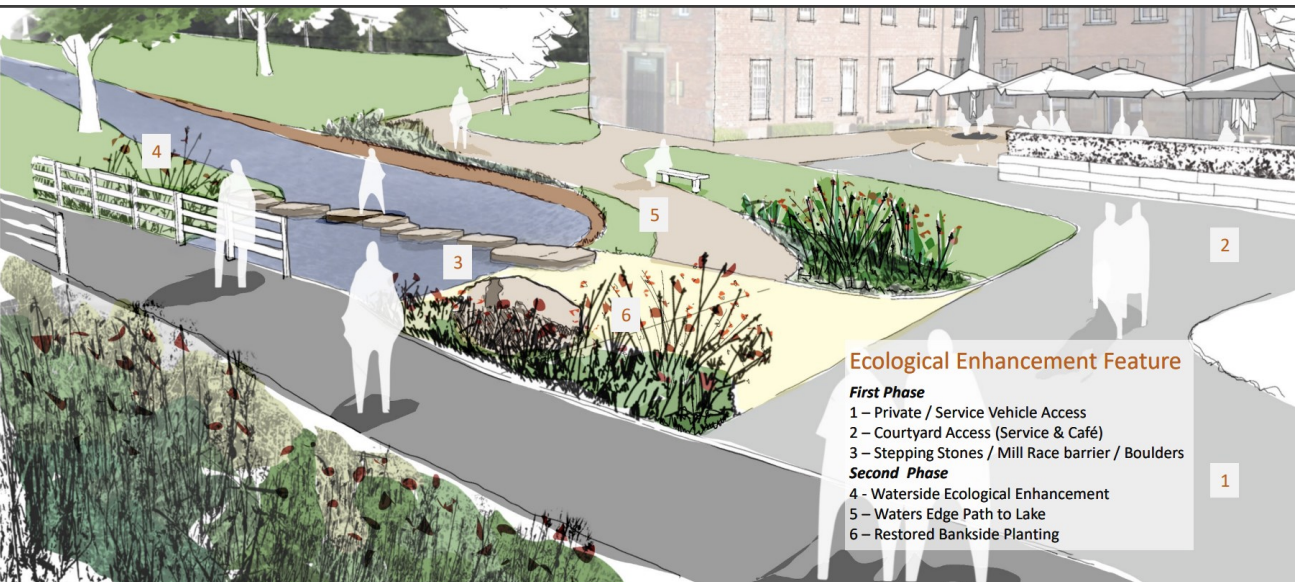
The current setup was supposed to be temporary. The original permanent closure proposal included a more sensitive, permanent scheme:
- Designed for Nature: A rewilded, environmentally sensitive closure that replaced concrete blocks with natural landscaping.